
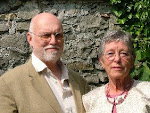
Birthday time, and we have celebrated jointly with a 160th party (82+78, I am the baby) with friends locally, a very informal wine tasting from our varied collecton. A few photos...


It has rained (a rare event) so things are looking a bit greener but this is a dry corner of the Languedoc - only 35 mm on 5 September when the local average all around was nearer 50 - and another 37 yesterday. I do spend a lot of my time watering, recycling the copious condensation from our wine store cooling system. I shalll need to get the mower out soon...
After an anxious few days Edmond has rallied and is eating the posher kind of dog food that now tempts him. His heart is not strong, and the vet (who is kind and thoughtful) is on standby to pay us a visit when needed, but for the moment the dog is in good spirits.
Followign the outstanding success of the Paris Olympics, the Paralympics have come and gone. We made a determined effort to watch: The simple evidence of determination and overcoming difficulties is inspiring, and sports have been adapted, or invented, to facilitate people with disabilities of every kind to take their chance. Now we are obliged to watch French tv, but we also have podcasts in English. There is a splendid podcast - well worth listening to - which conveys the excellence of these athletes. Mary and I both spent a good part of our working lives with disabled people in the voluntery sector, so this inteterests us a lot. It seems to us that France has begun to catch up with the UK in social integration of disability

I have long been interested in road safety, and the consistently higher mortality here as compared th the UK. I have just read that the number of people killed or injured on Welsh roads has dropped significantly since most 30mph speed limits were reduced to 20mph. There were 377 casualties on 20mph and 30mph roads in the first quarter of 2024, down from 510 in the same period last year. The number of deaths dropped from 11 to five.

 |
| The Fête des Associations, an annual event in most French towns. The voluntary sector is central to public affairs at every level. |

Those who know me also know I have a particular feeling of sympathy with refugees. I've written before about the book Bloody foreigners by Robert Winder, which is a classic view of l'étranger in Britain, something I return to read often. He has just written in the Guardian:
...there is a pattern stretching back to the 12th century.... Like everyone else, I gaped in dismay as rioting tore across the country... but as the reflexive search for the “root” or “underlying” cause gathered pace, I couldn’t help recalling the parable of the good sociologist. In this parody of the Bible, when the traveller on the road to Jericho is assaulted, the first sociologist crosses the road and passes by on the other side. The second does the same. But the good sociologist rushes to the scene, cradles the victim’s head and weeps: “Boy, the person who did this needs help.” The violence was the opposite of a laughing matter, but I groaned to see how swiftly it was taken to be symptomatic of a credible point of view. Almost everyone was calling the stone-throwers “far-right protesters” or “Islamophobic” – as though name-calling might be enough make them come to their senses. Surely this was giving them too much credit. It allowed them to style themselves as warriors for a cause instead of thugs. Worse, it walked into the Faragian trap of insisting that though the violence, yes, might be over the top, the grievances were understandable, and the conversation we really needed to have was about … immigration.
It wasn’t. The subject here was violence.This is not to say that immigration is trivial or a simple matter. It is neither. The Channel is being crossed by overcrowded boats. The government is having to spend up to £5bn a year on asylum seekers. That is inspiring enough culture-war friction to keep the thinktanks occupied for years. There are major policy discussions to be had in all these areas. But it pained me to see what was obviously a criminal uproar so swiftly becoming a “debate”. Surely, if there is one thing we could agree on, it was the fact that it is wrong for someone halfway through a six-pack to be setting fire to someone’s car, in a town (not their own) where children have just been murdered, because someone on the internet has said something angry about someone else whose name they couldn’t remember.
Part of my twinge was selfish, down to the fact that some years ago I wrote a book that presented the age-old saga of migration to Britain (since the ice melted) not as a sociopolitical nightmare but as a natural part of human life – which happened to have enriched Britain greatly. I was mindful of Tolstoy’s observation that in all literature there were really only two stories: someone leaves home, or a stranger arrives in town. But given that one of my hopes had been to pour oil on troubled waters, it looked as though I now had to admit – as flames lit up the night sky in Southport and Plymouth – that I had written the most unsuccessful book in the history of books.Except, perhaps, in one respect, because one of the main things I learned writing it was that angry summer uprisings against perceived outsiders are nothing new. Far from being a heated response to a modern problem, they are as entrenched a part of the English social scene as Ascot, Henley and the Lord’s Test.
Along with Robert Winder I have been reminded today of another favourite author, Lea Ypi, now a professor at the LSE but born in a dysfunctional Albania.
One cold, late evening in the winter of 1999, I was waiting for a train at Termini station in Rome when I noticed an old lady struggling with her suitcases and offered to help. “Signorina,” her voice trembled ever so slightly. “Fortunately there are still youngsters like you. I was very worried. This station is full of Albanian muggers. It’s an invasion.”
Back then I had no courage to tell her I was Albanian. One of the lucky ones – a student on a scholarship, unlike my fellow citizens who worked as cleaners, builders, carers and sex workers. ...taken literally, the only invasion in the history of the two nations went the other way round. It happened in 1939, when Mussolini’s troops ...annexed the Albanian kingdom to the kingdom of Italy.
Keir Starmer has reportedly declared that the UK government is interested in a migration pact like the Albanian one. ...all that Britain needs for an equivalent deal is a former colony with a government whose memory is sharp enough to remember the roads and buildings its master constructed in the past century but not the human beings it exploited in the past few decades.... When the argument that we must “be pragmatic” is the first to be put on the table, principles – memory, responsibility, care for vulnerable people, you name it – have already been suspended.
How to oppose it, then? Perhaps by plain logic. Migration deals such as the one Labour is apparently studying are premised on various assumptions: that migration itself is a problem, that irregular migration is best fought with draconian border restrictions, that extraterritorial detention can act as a deterrent. There is ample research showing each premise to be dubious. But even assuming they are valid, there are three further issues any “pragmatic” politician ought to confront.
Politically, the Albania model is presented as a novelty in the management of migratory flows because it involves cooperation between an EU candidate and an EU member state. ... [but this] leaves to bilateral negotiations what ought to come about as a result of an EU-wide process.... it creates a dangerous precedent in which individual countries pursue their own deals to address their own migration “problem”, heading off chances of a truly coordinated process acrossEurope.
Second, the principle of non-refoulment enshrined in the 1951 UN convention relating to the status of refugees, prohibits the expulsion or return of people to countries deemed unsafe. Meloni insists Albania is safe, citing its EU candidate status. But if that is the case, why are pregnant women, children and other vulnerable categories exempted from the deal?
Third, there is the economic question. To comply with international law, deported migrants must remain Italy’s responsibility. According to the agreement between Italy and Albania, Italy is responsible for all the costs of construction and management of the two centres...An irregular migrant in Albania costs Italy the same or more than they would if they were processed in their own territory. The only benefit is that migrants become invisible – lontano dagli occhi, lontano dal cuore, as the Italian saying goes.
We are told that Starmer’s government is pragmatic and interested in what works. But how can a “solution” that makes no logical sense from a political, legal and economic point of view still be considered “pragmatic”?
Perhaps there is only one plausible answer: propaganda. Labour clearly thinks it can send a message to the most right-leaning voters in its coalition that it too is tough on migrants. In doing this, it takes its liberal and leftwing supporters for granted. They may suspend their principles and forgive the rhetoric for a time. But the political, legal and economic contradictions will remain.


No comments:
Post a Comment