
| If music be the food of love, | If music be the food of love, play on, |
| Sing on till I am fill’d with joy; | Give me excess of it.... |
| For then my list’ning soul you move | |
| To pleasures that can never cloy. | (Shakespeare, 12th night) |
| (song by Henry Purcell) | |


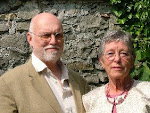
Since I was in my 20s I have both played recorders in early music groups - Mary joined in after we met. After my early days with the Canterbury Waits (still going - this must be one of the longest-existing early music groups in the UK, and its founder Chris Clifford is now running the New Zealand Early Music Festival) and years of playing in recorder consorts with my friend and mentor Ruth Liebrecht in Hampstead, I was fortunate to meet wonderful singing teachers and fellow performers through the Early Music Centre in London. I also enjoyed a period of excellent baroque singing in the Canonbury Chamber Choir before we moved to the Midlands, and even after our move I continued singing Schubert in London with my wonderful accompanist Joan Robinson, with whom I did many weekend courses and some concerts at the Edinburgh Festival Fringe. Ruth and Joan are sadly no longer alive and I miss them both for so many reasons.
Our time in Derbyshire gave us musical opportunities despite busy working lives - I sang in choirs in Nottingham and Derbyshire, we both conducted choirs for short periods (Mary more successfully than me!) and Mary played in the local community orchestra, while we both played renaissance wind instruments in our own Wirksworth Early Music Group. But it wasn't until we retired and moved that we really had time to practise and seek out new musical opportunities. Mary is better at practising than me - I'm usually too lazy.
We came to France with a huge collection of sheet music, and we have had occasions to play consort music with like-minded enthusiasts from time to time. But unlike we British, generally the French don't like to sight-read - instrumentalists and singers prefer to have practised pieces before they meet to play them, either in formal rehearsals or for fun. So we had fewer opportunities to play and sing until we met the right people after several years, and often we have to sit through very long-winded and repetitive sessions with a small repertoire.

 Now, after many false starts and blind alleys, we have found a rewarding and varied musical life. Mary now has a good 'cello teacher in the music school in Vauvert where she plays in a couple of chamber groups. She has also just acquire a second cello which she keeps at baroque pitch so we can play with our friend Karen, a harpsichordist who helps us improve our baroque style when we visit her little music school near Montepllier. I've had 2 really good singing teachers, Christian Buono and Kamala Calderoni who have between them improved my technique and range as a tenor, a welcome bonus as I near 70 years old. For me now there are 2 very productive choral groups, B.a.Bach in Montpellier which, as the name implies, performs the works of J.S.Bach, and Ochoeur, a septet singing mainly a cappella pieces of all styles and periods; with Mary helping out occasionally as accompanist. Together, we have a baroque trio sonata group Ensemble 344 with our friends Charles (harpsichord and organ) and Pierre (recorder) with whom we have played many recitals. More on all these in later blogs.
Things change - we all get older and musical capacities are limited by physical ailments. But for now we can reflect on an unexpectedly rich and rewarding musical life. As I write we are just approaching a weekend of Epiphany concerts with B.a.Bach - a cantata from the Christmas Oratorio and other seasonal Bach.
The Purcell part song at the start of this post, by the way, was Ochoeur's signature piece for a while. The author is Colonel Henry Heveningham (1651-1700)

No comments:
Post a Comment